





Blog
Stubble Burning and Its Hidden Impact

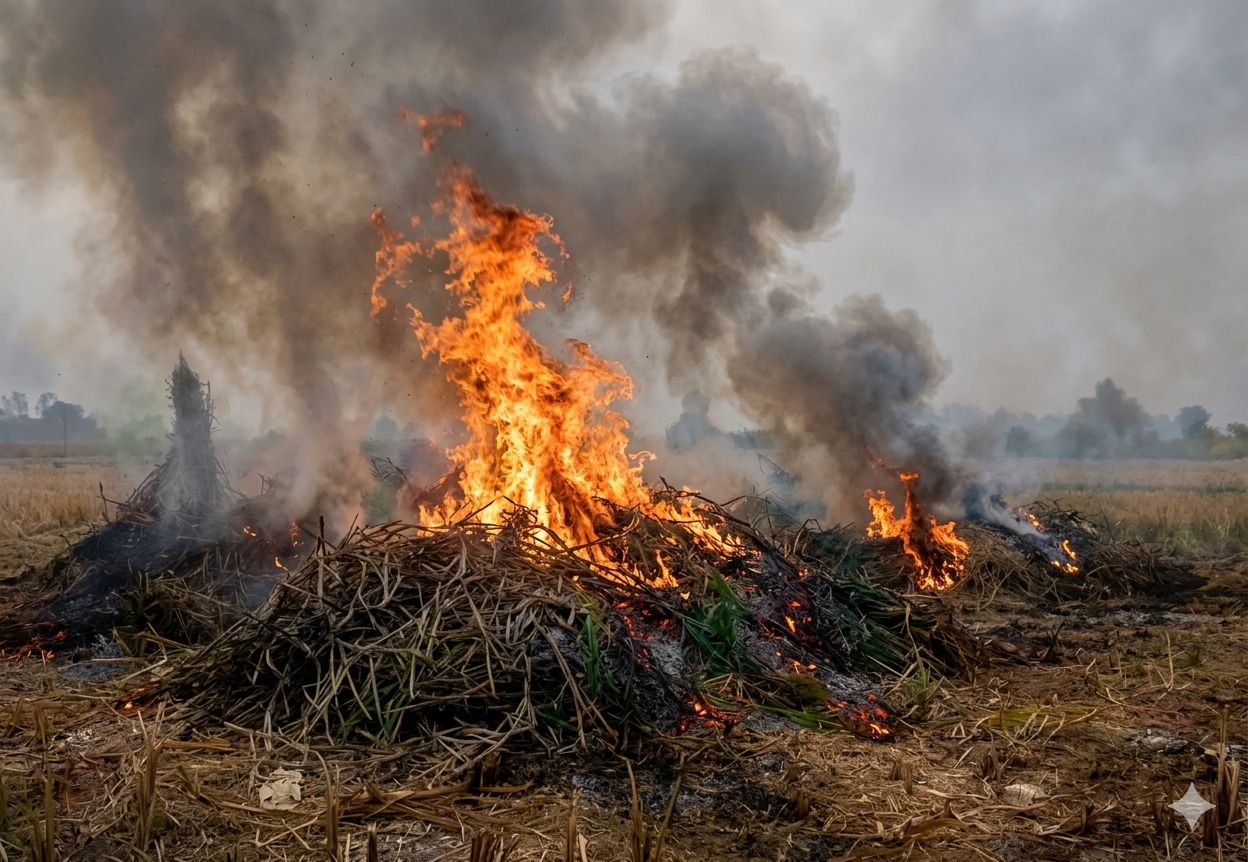
Every autumn and spring, a familiar, dense gray smog blankets the skies over northern India and surrounding regions. The imagery has become an unfortunate annual marker: satellite maps lit up with red thermal dots representing thousands of open crop-residue fires.
To the under-pressure farmer, setting fire to leftover rice or wheat stubble is a quick, desperate bid to clear the land. With a razor-thin window of about 15 days between harvesting one crop and sowing the next, open burning seems like the most cost-effective and efficient choice.
But while the visible smoke choke points are well-documented, the practice carries an invisible, devastating toll. Beyond the headline-grabbing air pollution indexes, stubble burning is quietly bankrupting our soil, accelerating a rural health emergency, and draining billions from the economy.
. The Under the Surface Crisis : Soil Stripping
The most direct, yet heavily overlooked, casualty of open burning is the agricultural land itself. A field is not an inert patch of dirt; it is a living, breathing ecosystem.
When a field is set ablaze, the intense heat penetrates the topsoil layer, triggering catastrophic losses:
-
Nutrient Vaporization: The fire instantly burns up vital macro and micronutrients. A single cycle of heavy stubble burning destroys millions of kilograms of organic carbon, along with essential nitrogen, phosphorus, and potassium—the fundamental building blocks of plant health.
-
Slaughtering the Microflora: The surface heat kills off millions of beneficial soil microbes, fungi, and earthworms. These organisms are responsible for natural decomposition, nutrient cycling, and maintaining a porous soil structure. Without them, the soil loses its water-retention capacity and gradually hardens into a sterile, degraded medium.
-
The Irony of Higher Costs: To make up for the self-inflicted loss of natural fertility, farmers are forced to buy and dump increasingly massive quantities of synthetic chemical fertilizers in subsequent seasons. This creates a vicious cycle of skyrocketing input costs and deteriorating soil health.